Shotokan or Shito-Ryu: Why Your Training Feels the Way It Does
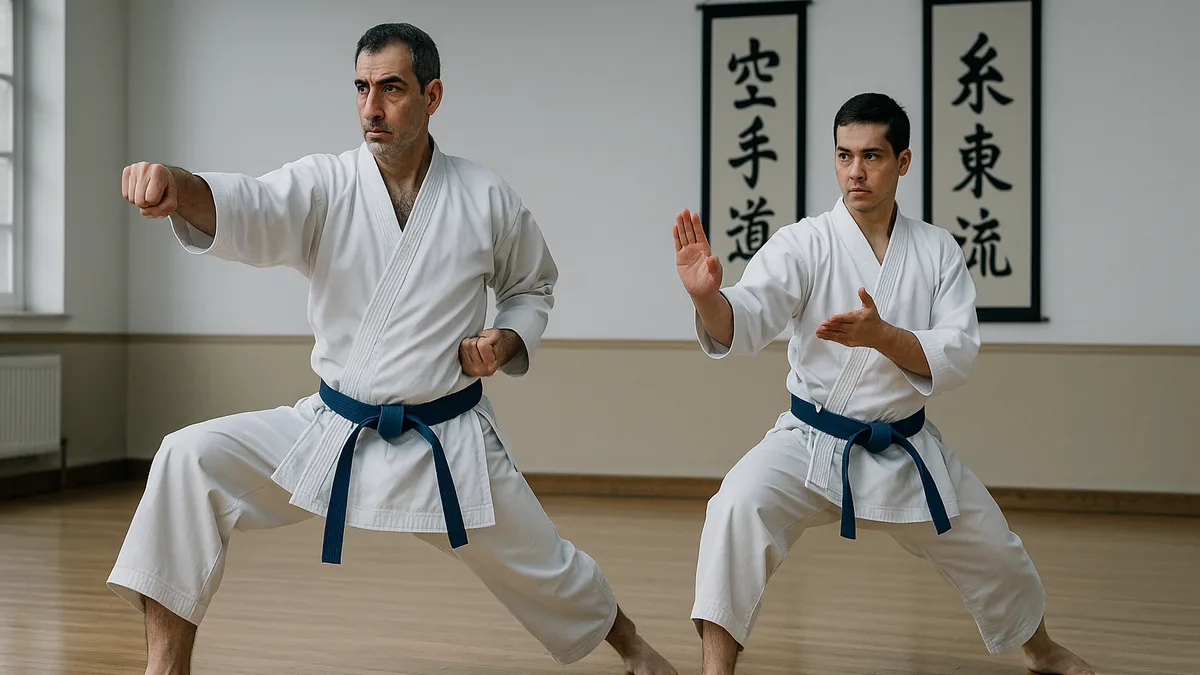
If you train Shotokan or Shito-Ryu, you have probably noticed that the two styles feel fundamentally different - not just in stance depth or kata syllabus, but in what a class expects of you. That difference goes back to a fork in the road taken by two men who studied under the same Okinawan masters and then built entirely different things from that shared foundation.
Understanding why that fork happened is genuinely useful for your training. It tells you what your style was designed to do well, and where its natural blind spots are.
Two Masters, Two Central Questions
Gichin Funakoshi and Kenwa Mabuni were both serious Okinawan practitioners with overlapping teachers. Both wanted karate recognised as a legitimate art on the Japanese mainland. But the question each man put at the centre of his work was different, and that difference shaped everything.
Funakoshi's core concern was what karate does to a person. His Twenty Precepts - the Niju Kun - drew heavily on Bushido and Zen principles, and his philosophical position that there is no first attack in karate was not primarily a tactical instruction. It was a statement about character. When his demonstrations caught the attention of Jigoro Kano and karate began finding its way into Japanese educational institutions, Funakoshi's approach aligned naturally with that context. Karate as physical and moral education.
Mabuni's core concern was what the techniques actually do. He trained under both Itosu and Higaonna - two masters whose methods were genuinely distinct, one rooted in straight, powerful Shuri-te methods and the other in the circular, close-range work of Naha-te - and he spent his career cross-referencing applications and preserving technical content. The very name Shito-Ryu encodes this dual inheritance, drawn from the first kanji of each teacher's name. Mabuni was not building a system for character development. He was preserving a fighting art and making sure nothing got lost in translation.
What Each Style Does Well, and Where It Tends to Fall Short
Shotokan's emphasis on kihon - long sequences of basics performed with full commitment, deep stances, strong kime - is not just about building power. It is building a particular quality of attention. The correction in a Shotokan class is almost always about commitment rather than efficiency: drive through the stance, extend fully, feel that moment of total focus through the whole body. That discipline is a genuine strength.
The vulnerability is bunkai. When a style is built around character development and spiritual growth, technical application can become secondary - and in many Shotokan dojos, it has stayed secondary for generations. Kata are executed with impressive precision and understood poorly. If your dojo cannot work through what each sequence is actually defending against, that is not a Shotokan problem as such, but it is a common enough gap to be worth examining honestly.
Shito-Ryu's higher, more mobile stances and faster range-closing footwork are not stylistic preferences - they are a direct consequence of Higaonna's Naha-te influence. The style carries a much larger kata syllabus than Shotokan, and that breadth was deliberate: Mabuni treated kata as technical libraries, and practitioners are expected to understand and demonstrate applications, not just perform sequences cleanly. That expectation creates a different kind of accountability in grading and teaching.
The corresponding trap in Shito-Ryu is collecting kata rather than internalising them. Knowing forty or more forms is only an advantage if the depth is there to match the breadth. A large syllabus can become a distraction from the serious work of making even a handful of kata instinctive under pressure.
"Kata performed without understanding of application is exercise, not karate."
That applies equally in both styles. The correction is the same wherever you train.
A Generational Shift Worth Knowing About
There is a growing movement across both styles - particularly among younger practitioners - back toward serious bunkai research. Work from people like Iain Abernethy, and from Okinawan masters who never accepted kata as purely formal exercises, is pulling Shotokan and Shito-Ryu practitioners alike toward a more technically rigorous approach to application. This is worth paying attention to regardless of which style you train, because it represents a correction to the drift that Funakoshi's philosophical emphasis - and the institutional spread of karate generally - allowed to develop.
Take This to Your Next Class
- If you train Shotokan: Ask yourself honestly whether your dojo treats bunkai as a serious subject. If kata applications are rushed or skipped, that is the gap to address first.
- If you train Shito-Ryu: Count how many kata you can apply under pressure, not just perform. That number is more useful than the total you have learned.
- In either style: Find at least one training partner willing to work through kata applications with you outside of formal class time. Partner work is where the gap between form and function closes.
- Before your next grading: Know not just the sequence but the intent behind at least three techniques in each kata you are being assessed on.
- If you are considering switching styles: The technical adjustment is manageable. The shift in what the style asks of you - philosophically and technically - takes longer to navigate than most people expect.
For the complete version, with every drill explained, read Funakoshi vs Mabuni: How Two Students of the Same Masters Built Completely Different Styles on Karate Lifestyle.
More from Karate Lifestyle


Comments
Post a Comment