Shotokan or Kyokushin? What Each Style Actually Builds (And Where It Falls Short)
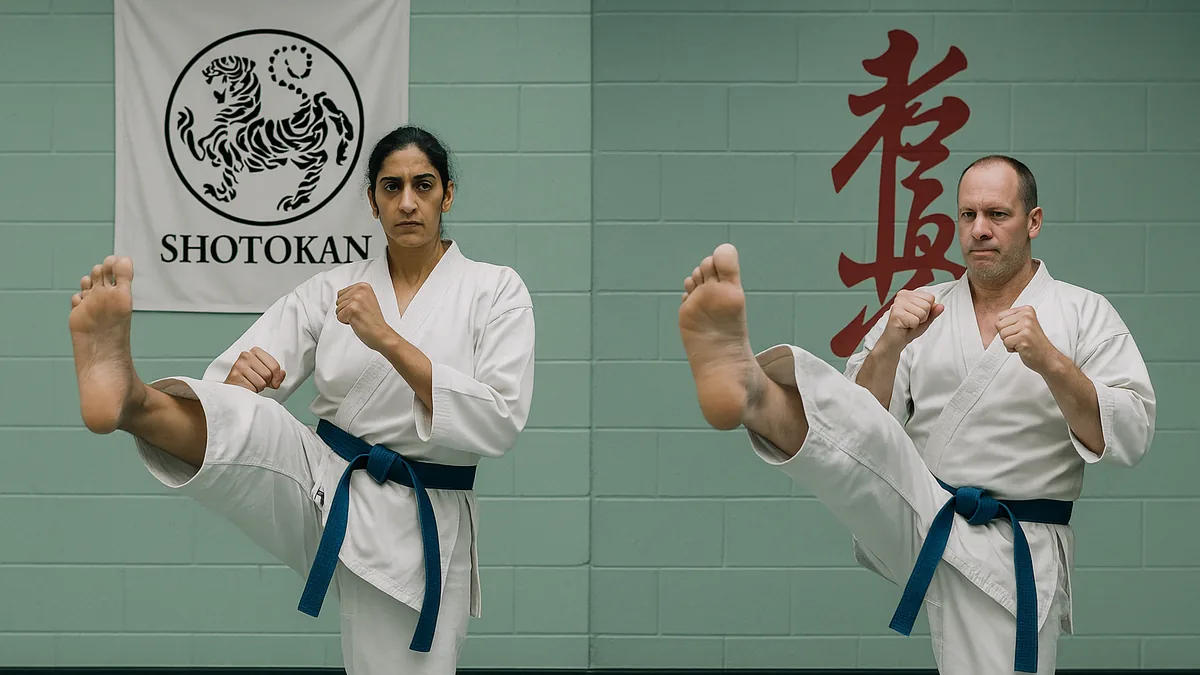
Whether you train Shotokan or Kyokushin, you have probably had the conversation - someone from the other style tells you your sparring is unrealistic, or your stances are impractical, or your kata has drifted away from anything resembling a fight. The frustrating thing is that both sides usually have a point. Understanding why helps you train more honestly, whichever badge is on your gi.
What the Stances Are Actually For
Shotokan's long, low stances are not a stylistic quirk or a historical accident. They are an engineering decision. The deep zenkutsu-dachi exists to create a platform for generating power through hip rotation and body mass. When it works properly, the rear leg drives, the hip rotates, and the fist arrives as the end point of a chain that starts in the floor. The arm is almost incidental.
This is where many beginners go wrong - they try to punch harder with the arm rather than learning to stop punching with it. The hip rotation is the whole technique.
Kyokushin uses shorter, higher stances in sparring, and this is equally logical. When someone is landing full-power leg kicks and body strikes, a deep rooted stance becomes a liability rather than an asset. Mobility matters. The stance adapts to the contact level, not the other way around.
So this is a genuine disagreement, not one style being sloppy and the other being correct. Shotokan prioritises structural power generation; Kyokushin prioritises mobility under real pressure. Both are deliberate choices with real consequences for how your body develops.
The Sparring Gap - Honest Assessments on Both Sides
This is where the debate gets heated, and where both styles have something uncomfortable to hear.
Shotokan competition is predominantly point-based and controlled. The premium is on timing, distance management, and landing the first clean technique. Trained seriously, this produces practitioners with sophisticated ma-ai and precise single strikes. What it does not automatically produce is the ability to function after absorbing a hard strike - because in point sparring, you rarely have to.
Kyokushin's full-contact format does develop that quality. By the time a Kyokushin practitioner reaches black belt, they have been hit hard, repeatedly, and learned to keep moving. That is a genuinely difficult thing to develop, and controlled sparring cannot replicate it.
But Kyokushin has its own structural problem: the no-face-punch rule. Because head punches are absent from competition, competitors can build comfort absorbing body shots without ever developing realistic defence against punches to the head. The rule shapes training habits whether practitioners acknowledge it or not.
"The more experienced the practitioner, the more likely they are to acknowledge what their own style does not cover."
This is the honest position: Shotokan produces better distance management and technique precision; Kyokushin produces better conditioning and genuine toughness. Neither is complete on its own.
Kata: Shared Forms, Different Priorities
Both styles practice kata, and several forms appear in both curricula. But the weight placed on kata differs considerably. In Shotokan, it sits at the centre of the grading syllabus and competitive structure. In Kyokushin, it is present but the culture is built around the sparring floor.
The mistake that shows up in both styles is treating kata and kumite as separate disciplines. A practitioner who performs kata beautifully but cannot apply any of it under pressure has learned a performance skill. A practitioner who spars hard but never works kata is missing a structured method for developing individual technique. The two are supposed to feed each other, and in most dojos, they do not do so nearly enough.
Checklist for Your Next Class
Whichever style you train, take these questions with you:
- If you train Shotokan: When you throw gyaku-zuki in kihon, is the power coming from the hip and rear leg, or are you still punching with the arm? If you are not sure, ask your sensei to watch specifically for this.
- If you train Kyokushin: When did you last work defence against head-level punches? If your sparring never requires it, find a way to supplement it - structured pad work or cross-training.
- In either style: Pick one sequence from your current kata and work out what it is actually for. Then try to apply the underlying principle in sparring, however roughly. If you cannot make any connection between the two, that is worth raising with your coach.
- In either style: Notice whether your club's culture treats kata and kumite as connected or separate. If they feel like two different subjects taught by the same instructor, consider asking why.
- Regardless of style: If you find yourself defending your style against the other rather than thinking about what yours does not cover, that is a useful signal. The gap you are not looking at is usually the one that matters.
For the complete version, with every drill explained, read Shotokan vs Kyokushin: Why Two of the World's Biggest Styles Disagree on Almost Everything That Matters on Karate Lifestyle.
Join the conversation: Facebook · X · Pinterest · Threads · Bluesky
More from Karate Lifestyle


Comments
Post a Comment