Same Roots, Different Trees: Making Sense of Kyokushin and Goju-Ryu
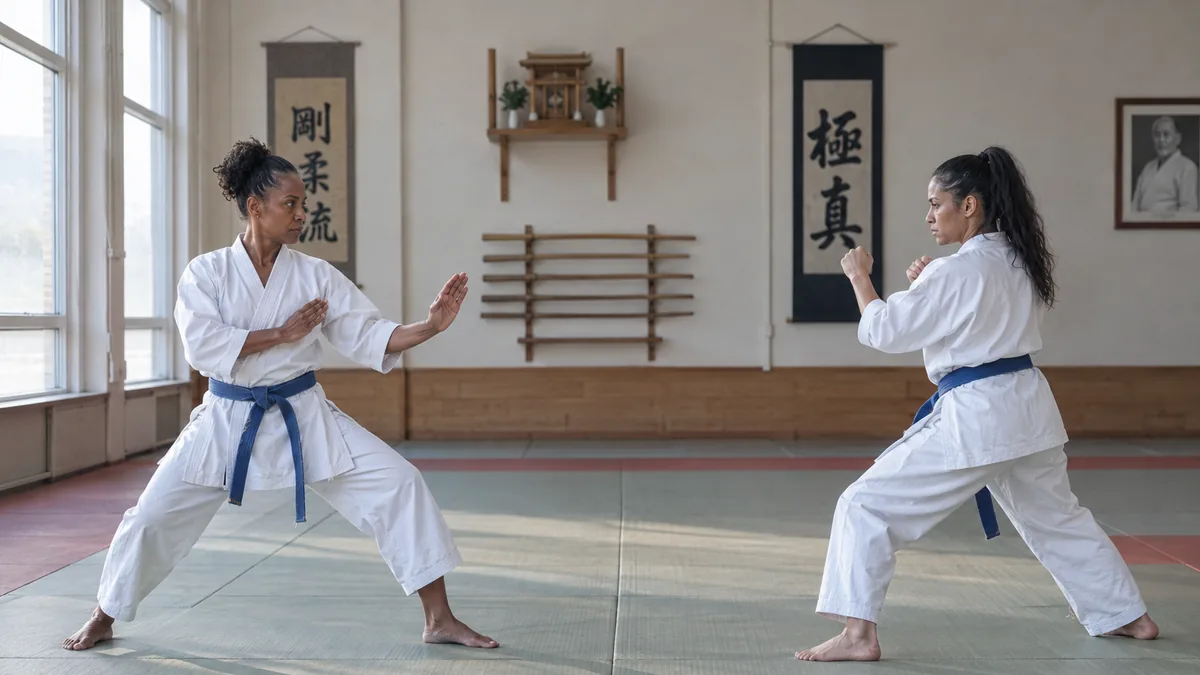
If you have ever watched a Kyokushin fighter and a Goju-Ryu practitioner spar and wondered how two styles sharing the same ancestor could feel so different, you are asking exactly the right question. The answer is not about one style being a corruption of the other. It is about each one being built to answer a completely different question.
This guide pulls out the practical implications so you can take something useful into your next class, whether you train Kyokushin, Goju-Ryu, or you are just trying to understand the landscape.
What Each Style Is Actually Built Around
Goju-Ryu's identity lives in its kata. That is not a generalisation - it is a structural fact about how the style transmits its content. Sanchin is not a warm-up or a beginner exercise. It is a diagnostic form that tests whether your breath, your stance, your abdominal engagement and your shoulder structure are all working as one connected unit rather than as separate moving parts. Spending time with a senior who can physically test your structure mid-kata makes this immediately clear.
Strip the kata from Goju-Ryu and you have not simplified it. You have removed the thing that makes it Goju-Ryu.
Kyokushin was built around a different question: what does karate look like when you test it under full-contact conditions? The answer reorganised the priorities completely. Conditioning, body hardening and the ability to function under sustained physical pressure moved to the centre. Kata stayed in the syllabus and carries genuine technical value, but it is not where the style's identity is anchored. A Kyokushin practitioner who excels in kumite and conditioning but is unremarkable at kata is still clearly a Kyokushin practitioner. That is not a criticism - it is an accurate description of where the emphasis sits.
The Sparring Difference Is Bigger Than It Looks
The most consequential practical difference between the two styles is how they spar, and it shapes everything else about how practitioners move and make decisions.
Kyokushin's no-head-punch rule is commonly misread as a safety measure. In practice, it means that body strikes are thrown with full commitment and leg kicks are not pulled. Practitioners coming in from lighter-contact backgrounds often make the mistake of staying upright and keeping a high guard - and that approach gets corrected quickly and painfully. What actually works is dropping the weight, tightening the core in anticipation of contact, and committing to a counter rather than stepping away, because stepping away just means absorbing the next shot while moving backwards.
Goju-Ryu sparring varies considerably between organisations and dojo. Some schools work jiyu-kumite with controlled contact, others prioritise bunkai-based partner drilling as their primary form of alive practice. What you will rarely encounter in a traditional Goju-Ryu context is the kind of sustained full-power body exchange that is routine in a serious Kyokushin session.
Both formats have genuine value. They are just testing different things.
Where the Honest Assessment Lands
"The honest position is that both styles made real trade-offs, and understanding those trade-offs is more useful than defending one side of the argument."
Goju-Ryu practitioners sometimes point out that Kyokushin's competition-driven development meant that close-range grappling, breathing-based power and the subtler kata applications were deprioritised over time. That observation is fair.
Kyokushin practitioners counter that a style which cannot produce practitioners who function under real physical pressure has its own significant gaps, regardless of how rich its kata curriculum is. That is also fair.
What tends to happen with experience is that both critiques start to land simultaneously. Senior Kyokushin practitioners frequently develop a serious interest in kata application once they move past their peak competition years. Experienced Goju-Ryu practitioners often acknowledge that if their sparring stays too controlled for too long, it can produce habits that would not hold up under genuine pressure. Neither style has the complete picture. Both are coherent answers to specific questions.
Checklist for Your Next Class
- Goju-Ryu practitioners: Ask your instructor to test your structure during Sanchin rather than just watching it. The difference between isolated tension and whole-body integration is felt, not seen.
- Kyokushin practitioners: When you spar, notice whether you are retreating under body pressure or countering into it. Retreating is often a habit from lighter-contact training.
- Both: Identify one kata you share with the other style - Sanchin is the obvious candidate - and consider what the other tradition's approach to its application might add to your understanding.
- Goju-Ryu practitioners: If your sparring has stayed controlled for a long time, honestly assess whether your timing and structure would hold under harder contact.
- Kyokushin practitioners: If kata sits at the back of your training attention, look at the Goju-Ryu bunkai tradition for forms your syllabus shares. The context it adds is worth the time.
- Both: Resist the urge to frame the comparison as one style being better. The more useful question is which training environment matches what you are actually trying to develop.
For the complete version, with every drill explained, read Kyokushin vs Goju-Ryu: Why a Style Born from Goju-Ryu Ended Up Looking So Different From Its Parent on Karate Lifestyle.
Join the conversation: Facebook · Instagram · X · LinkedIn · Pinterest · Threads · Bluesky
More from Karate Lifestyle


Comments
Post a Comment