Same Coin, Different Sides: Training Kata and Kumite as One Thing
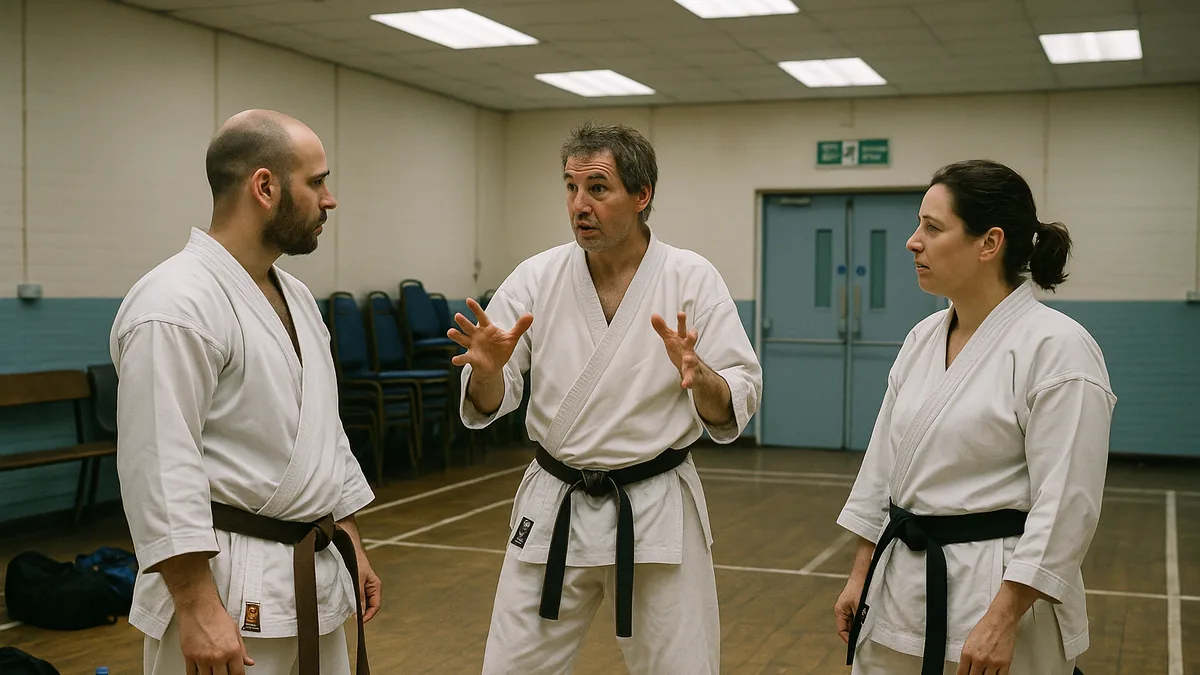
Most karate practitioners have a preference. Some live for the sparring floor and treat kata as a necessary inconvenience before gradings. Others could spend hours refining a form and quietly dread jiyu-kumite. Both groups are missing something - and the article this post accompanies argues that the kata-versus-kumite debate is not really a debate at all. It is a symptom of incomplete training.
Here is a practical way to think about what that means for your next session.
The Preference Reveals the Gap
Where you started in karate shapes what you value. If you were never taught to extract meaning from kata movements - to ask what that pivot, that pull-back hand, or that chambered position is actually doing - then of course kata feels like theatre. Conversely, if your early training was heavily form-based without any pressure-testing of applications, sparring can feel chaotic and unconnected to everything you have drilled.
Neither starting point is a character flaw. But both become a problem if the preference hardens into avoidance. The practitioner who strongly favours one discipline is almost always avoiding the feedback the other one provides.
What You Are Actually Missing
If kata is your comfort zone: The risk is that you have trained the shape without training the intent. Smoothness and precise lines are outputs of correct understanding, not the understanding itself. Movement that looks right but carries no structural weight is movement that will not hold up when a partner resists. Drilling bunkai - the practical application of kata movements - with even a lightly resistant partner will tell you very quickly whether your mechanics are functional or decorative. If the application falls apart, that is information about the kata work, not a reason to dismiss the application.
If kumite is your comfort zone: The techniques you reach for under pressure are the ones that are easy to land - fast, direct, low-commitment. The more complex mechanics tend to stay on the shelf: off-angle entries, simultaneous block-and-counter, close-range weight transfer into a finish. Kata is precisely where those mechanics live. They do not appear spontaneously in free sparring. They have to be drilled until they are automatic, and kata is the structure that makes that drilling possible.
There is also a timing point worth sitting with. Better timing in sparring is not purely a sparring problem. It is partly a body-mechanics problem. When the mechanics are automatic, the hesitation disappears - and timing improves as a consequence, not because you thought about timing more.
"Kata is compressed kumite. Kumite is expanded kata."
How to Train Both More Purposefully
The correction your instructor gives you in kata - drop your weight, commit through the hip, stop telegraphing - is the same correction that applies in sparring. It is never two separate problems. The dojos worth training in are the ones where your kata performance says something about your sparring, and your sparring reveals what needs work in your kata.
That connection only becomes visible when you treat every kata movement as purposeful. Not decorative, not choreographic, but purposeful. Ask what each movement does. Find a training partner and test it, even gently. Let the kumite inform which kata movements need more attention, and let the kata work build the mechanics that sparring will eventually test.
Checklist for Your Next Class
- Pick one kata sequence - even just three or four movements - and ask what each one is doing before you run the full form
- Drill one bunkai with a partner, then ask them to offer light resistance and see whether the mechanics hold
- Notice the next correction your instructor gives you in kata, then deliberately look for the same issue in your sparring
- Identify the technique you never use in jiyu-kumite and trace it back to where it lives in your kata - then drill that movement in isolation
- If you avoided one today - kata or kumite - make it the first thing you work on next session
For the complete version, with every drill explained, read The Kata vs Kumite Debate on Karate Lifestyle.
Join the conversation: X · Pinterest · Bluesky
More from Karate Lifestyle


Comments
Post a Comment