Pressure in Kumite: What You're Actually Doing When You Walk Forward
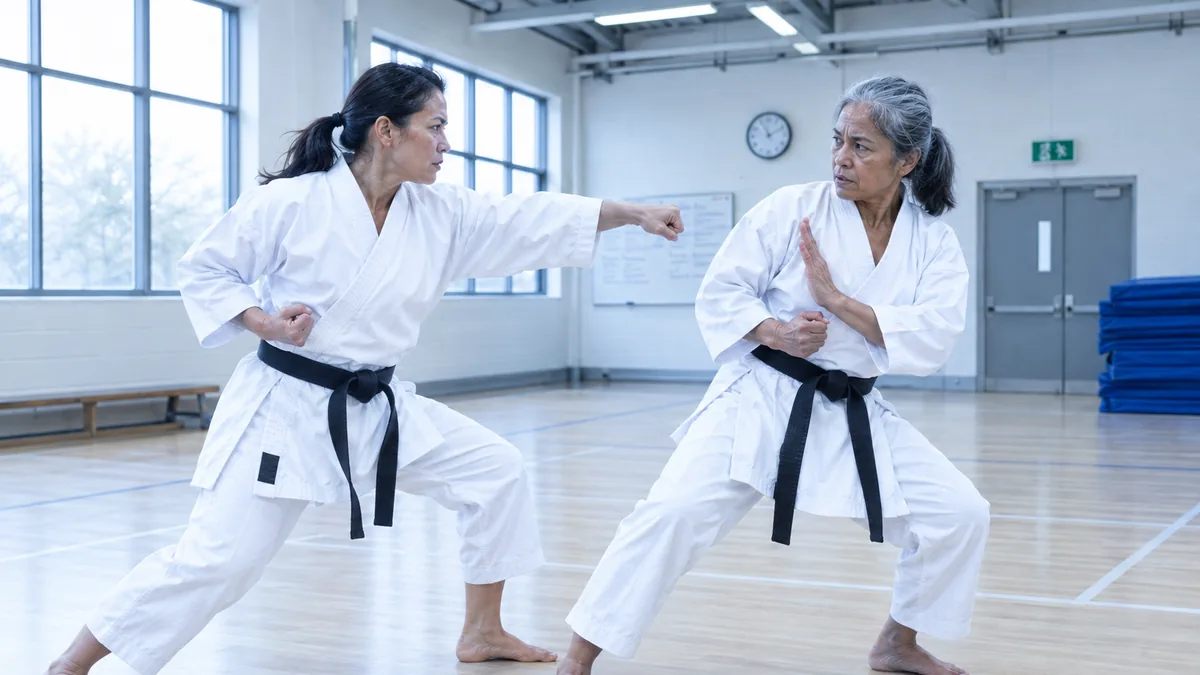
Most competitive karateka have, at some point, been told to "apply more pressure" and responded by walking forward faster. It feels like the right instinct. It rarely works for long. The full article on KarateLifestyle.uk digs into why, and offers three drills to build genuine pressure. This companion guide pulls out the practical core so you can take it into your next session.
Why Walking Forward Is Not the Same as Pressure
There is a difference between moving towards your opponent and making your opponent feel like every position they take is wrong. The first is locomotion. The second is pressure.
The problem with continuous forward movement is threefold. It hands your opponent a predictable rhythm they can score against - they know when your next step lands, so they know when to counter. It removes your ability to threaten from stillness, because if you are always moving in, there is no possibility of not moving, and that possibility is what creates genuine threat. And it is expensive: sustained forward movement without tactical variation burns energy and often ends up at clinch range, where things get complicated.
"A fighter who simply walks forward with no timing variation is not applying pressure. They are giving their opponent a metronome."
That is the core of it. A metronome is easy to work with once you have found the beat.
What Rhythm Disruption Actually Requires
The good news is that breaking your opponent's timing does not require exceptional speed or athleticism. The tools are straightforward: vary your step length, alter your breathing pattern, and insert a half-beat pause before you attack. That is enough to make your timing genuinely difficult to read.
Every fighter settles into a default rhythm - a pace, an attack interval, a reset distance. Once your opponent finds that rhythm, they can work with it. Disrupting it means they are always slightly off, their counters arriving a fraction too early or too late.
The half-beat pause is particularly underused. Rather than removing your forward movement, you interrupt it. The foot does not follow immediately. You hold the tension. Then you attack. The key is keeping your head still and maintaining eye contact through the pause - if your shoulders drop or your weight shifts visibly, you have telegraphed it and the effect is lost.
Feints follow the same logic. A feint only produces a reaction if it looks genuinely threatening. That means committing to the hip rotation and shoulder movement, even if the arm does not fully extend. A feint that barely moves is not a feint - it is a twitch, and your opponent will ignore it.
Distance Anchoring: The Skill Nobody Drills Enough
Controlling distance is not the same as managing distance reactively. The goal is to own a specific fighting distance and make your opponent uncomfortable whenever they try to change it. When done correctly, your opponent feels like they cannot find a position that suits them. That sensation - that claustrophobic inability to settle - is pressure.
This is a drillable skill, but it does not come quickly. Most fighters need several weeks of consistent, deliberate practice before distance anchoring becomes instinctive. General sparring alone will not develop it; you need to isolate it.
One thing fighters consistently forget when working on this: keep the lead hand active. Not grabbing, but present. A dropped lead hand removes half the pressure you are generating with your footwork.
Checklist for Your Next Session
- Before you spar: decide on your preferred fighting distance and commit to anchoring it throughout each round
- Vary your step length - mix short steps with longer explosive entries so your approach is not metronomic
- Insert at least one half-beat pause per exchange - hold the tension before you attack, keep your head still
- Test your feints: if your training partner is not reacting, your feint is too small - add hip rotation and shoulder commitment
- After sparring: ask yourself whether your opponent was choosing when to attack, or whether you were. If it was them, you were not applying pressure - you were just moving
- Note how quickly you fatigued - sustained forward movement without variation is physically expensive; rhythm disruption should feel more controlled, not more tiring
For the complete version, with every drill explained, read How to Use Pressure and Rhythm Disruption in Kumite: Why Constant Forward Movement Is Not the Same as Effective Pressure on Karate Lifestyle.
Join the conversation: Facebook · Instagram · X · LinkedIn · Pinterest · Threads · Bluesky
More from Karate Lifestyle


Comments
Post a Comment