Making Your Home Karate Sessions Actually Count
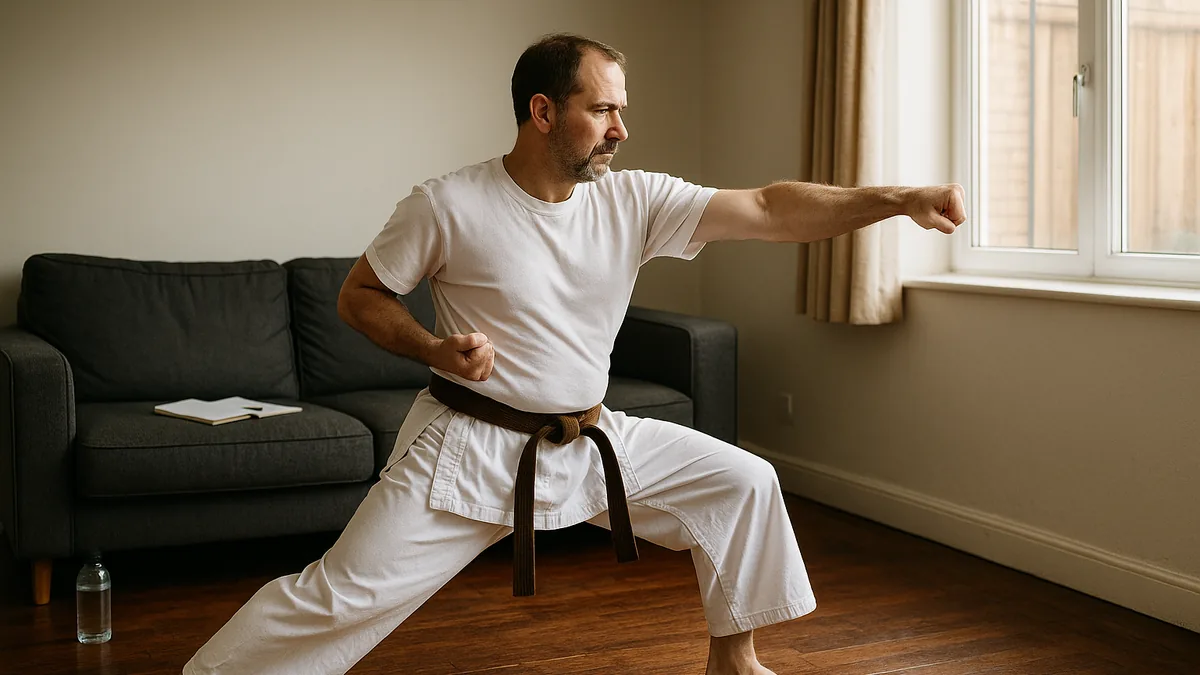
Home training works brilliantly when you use it correctly - and causes real problems when you don't. The key distinction is simple: home practice is for drilling what you already understand, not for learning anything new. If your instructor hasn't corrected a technique and you haven't felt the right version in the dojo, leave it alone at home. Drill it there and you're just cementing the error.
Here's how to make your solo sessions genuinely useful.
What to Actually Focus On
Stance work is the most underused tool in home training, and arguably where your time is best spent. It's easy to treat stances as incidental - the thing you happen to be doing while you punch or block. That's the wrong way around.
"The stance is the foundation that makes everything else possible."
If your zenkutsu-dachi is off, every oi-zuki built on top of it is also off, regardless of how many repetitions you put in. Spend time simply holding stances - not moving, not adding technique on top, just standing in the position and feeling whether your weight distribution, knee tracking and hip alignment are where they should be. It feels unproductive. It isn't.
Timing and internal rhythm also transfer well from solo work. Drilling combinations at home builds your sense of the pause before kime, the compression and release, the recovery after. These things are genuinely difficult to work on in class, where the group sets the pace.
What doesn't transfer is worth being honest about. Distance judgment, reaction to an opponent, and anything resembling pressure-testing all require another person. You cannot develop ma-ai on your own. Home training won't fix that, and pretending otherwise just creates a false sense of progress.
The Mistakes That Undo the Work
Training too fast is the most common problem. Speed feels productive. But if the mechanics aren't correct yet, faster repetitions just ingrain the error more deeply. Find the pace at which you can feel every stage of the movement, and work at that pace until it becomes automatic. Speed can come later.
Losing kime because there's no target. In the dojo, your technique has somewhere to go. At home, without a partner or a mark to aim at, the endpoint disappears and the focus degrades with it. Put a piece of tape on the wall at head height, or use any fixed visual reference. Your technique needs a destination.
Neglecting your weaker side. Left to choose freely, almost everyone drills their dominant side more. Actively match your repetitions on both sides, and lean toward spending extra time on the side that needs more work.
Drilling kata without understanding it. If you don't have a working understanding of what the techniques in a kata are for, drilling it at home mostly produces polished movement with no meaning behind it. That has limited value. If you're uncertain, focus on kihon instead and save kata for the dojo where it can be seen and corrected.
A Session Structure That Works
Shorter, more frequent sessions outperform long occasional ones for building lasting skill. Twenty to twenty-five minutes, done regularly, is more valuable than an hour once a week.
A format that holds up in practice:
- Five minutes of kihon on the spot - two or three techniques from your current syllabus, drilled slowly for accuracy rather than speed or power
- Five to ten minutes of moving basics - stepping combinations if your space allows, with attention on the transitions between techniques rather than the techniques themselves
- Five minutes of stance work - hold each stance for around thirty seconds, notice where you're compensating
- Five minutes on a single kata section - only if you have the space and genuinely understand the material; otherwise replace this with more kihon
You don't need equipment or a long warm-up for this kind of controlled drilling. A cleared corner of a room is enough for the stationary work. A hallway often serves better than a living room for anything involving footwork.
Before Your Next Session: A Quick Checklist
- Only drill techniques your instructor has already corrected and you've felt correctly in class
- Set a visual target on the wall before you start - something at head height
- Choose a pace slow enough that you can feel every part of each movement
- Include at least five minutes of stance holds with no added technique
- Match your repetitions on both sides, and give extra attention to the weaker one
- If you plan to include kata, make sure you can explain what at least the basic techniques in it are for
- Keep the session to twenty to twenty-five minutes rather than stretching it out
- Remind yourself what home training cannot give you: distance judgment, reaction and pressure all need a partner
For the complete version, with every drill explained, read How to Practise Karate at Home on Karate Lifestyle.
Join the conversation: X · LinkedIn · Pinterest · Bluesky
More from Karate Lifestyle


Comments
Post a Comment