Kumite Has a Progression - Are You Actually Following It?
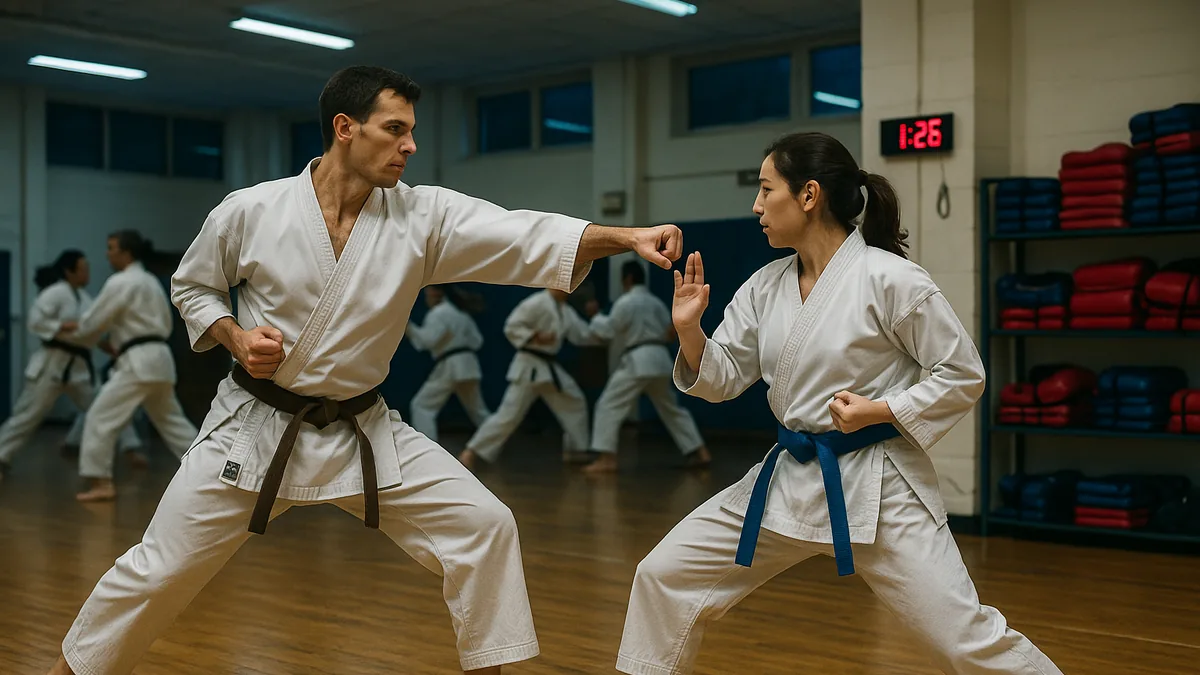
Most karateka know the names - gohon, sanbon, ippon, jiyu-ippon, jiyu-kumite. Fewer treat them as distinct training tools rather than a ladder to climb as quickly as possible. If your goal is to get to free sparring, you are probably getting less from kumite than you could be. Here is a practical way to think about what each stage is actually for, and what to watch for in your own practice.
Kumite Is Not Where You Apply Your Training - It Is Its Own Training
The common framing is that kihon and kata build the skills, and kumite is where you use them. That framing is wrong, or at least incomplete. Kihon builds motor patterns. Kata develops those patterns with intent and flow. Kumite builds something else entirely - the ability to make decisions under pressure when another person is actively working against you.
This is why technically strong students sometimes fall apart the moment they face a resisting partner. Their technique is fine. What they have not trained is the process of selecting and applying that technique in real time, when they cannot control the timing or the angle of what is coming at them. That is a genuinely different skill, and it only develops through partner work.
"Timing is the thing that kumite teaches that nothing else can, and it is the thing that takes longest to develop."
You cannot build that sense of timing through solo drilling. It comes from hours of working with partners across all the kumite forms - not just jiyu-kumite.
What Each Structured Form Is Actually Building
Gohon kumite is not just for white belts going through the motions. The real training here is learning to read a committed attack - to feel the difference between a half-hearted step and a fully committed one. The five repetitions give you enough reps to start sensing that. Do not waste them by just surviving each exchange.
Sanbon kumite is about managing distance over multiple exchanges. Students who handle gohon reasonably well often struggle here because they do not know how to control their retreat. They either run out of space or end up too far away to land the counter. This form also trains commitment - following through on three full attacks or three controlled retreats even when uncertainty creeps in.
Ippon kumite is where decision-making starts in earnest. The attack may be pre-agreed, but you are choosing your response. The most common error here is treating the block and counter as two separate actions - block, pause, counter. By the time the counter arrives, the opening has gone. The block should create the opening and the counter should fill it immediately, as one continuous movement. When it clicks, it feels like a single action rather than two.
Jiyu-ippon kumite is arguably where the most real technical development happens for intermediate students. The attacker announces the technique but chooses their own timing. Knowing what is coming and still struggling to deal with it tells you exactly where your timing and positioning are failing - you cannot blame surprise. This is structured enough to isolate specific problems but open enough to create genuine pressure.
Jiyu-kumite is primarily a testing environment. It is valuable, but it is better at revealing what you already have than at building new skills. Under free sparring pressure, most people default to what works rather than experimenting. If you only ever test, you stop developing.
Three Habits That Hold Kumite Development Back
- Treating every session as a competition. When students spar to win rather than to develop, they repeat what already works and stop building anything new. Kumite should feel like practice, not performance.
- Tensing up under real pressure. When a committed attack comes in, shoulders rise, breathing stops, and technique collapses. Telling yourself to relax does not fix this. The nervous system adapts through exposure, not instruction - which means more contact, more often, until the response becomes manageable. There is no mental shortcut.
- Neglecting kata alongside kumite. Students who do a lot of free sparring but not much kata tend to narrow their game down to two or three reliable techniques and repeat them. The development stops. Kata and kumite are complementary - one without the other leaves gaps.
Checklist for Your Next Class
- In gohon or sanbon, focus on reading the attack rather than just surviving it - can you feel the difference between a committed step and a hesitant one?
- In ippon kumite, work on making the block and counter feel like a single movement. If there is a pause in the middle, that is the specific thing to fix.
- In jiyu-ippon, use the structured format to diagnose real problems - if you knew what was coming and still got caught, something in your timing or positioning needs work.
- In jiyu-kumite, set yourself a development goal before you start rather than just sparring. Try something you are not comfortable with.
- If you tense up under pressure, ask for more contact in controlled drills rather than trying to think your way out of it.
- If you are a senior grade, go back to ippon kumite with full intent. If it feels easy, you are probably not doing it with enough commitment.
For the complete version, with every drill explained, read What Is Kumite? on Karate Lifestyle.
Join the conversation: X · Pinterest · Bluesky
More from Karate Lifestyle


Comments
Post a Comment