Kick Shield or Curved Pad: Which Should You Buy First?
Most people buying their first piece of pad equipment pick whichever is cheaper and assume the choice does not matter much. It does. The pad you train on shapes the feedback you receive, and feedback shapes technique. Getting this decision right at the start saves you from spending months reinforcing habits that will need correcting later.
This guide breaks down what each pad type actually offers, where each falls short, and how to decide which one belongs in your kit bag first.
What You Are Really Choosing Between
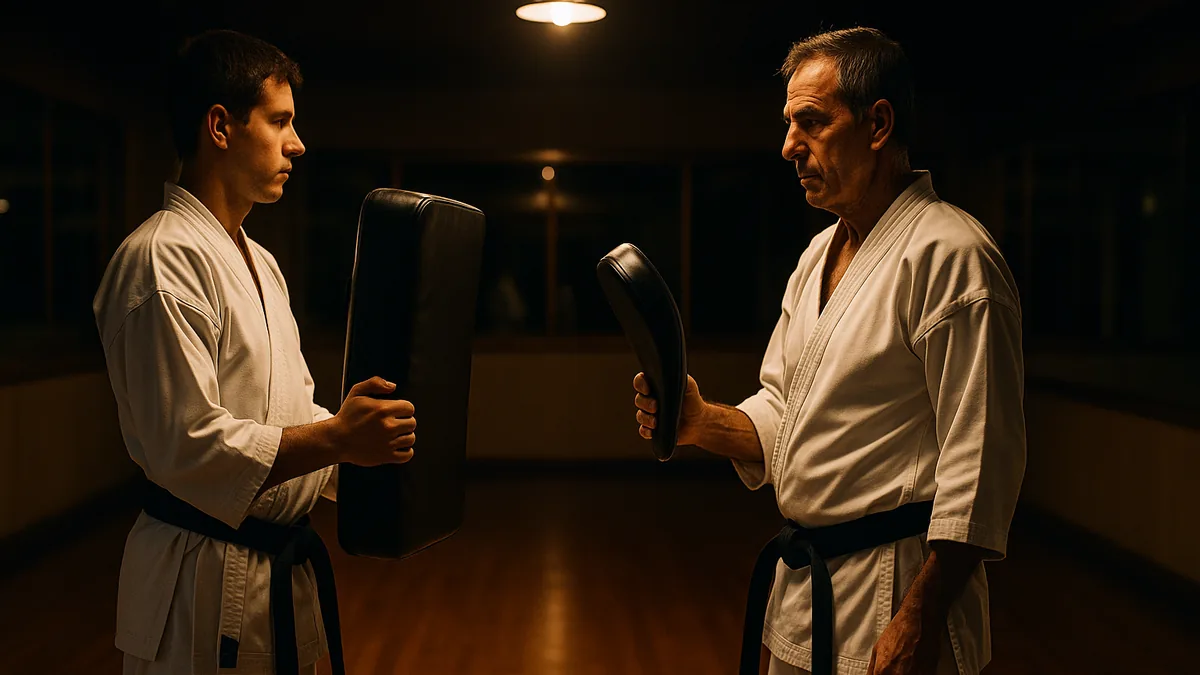
A kick shield is large, forgiving, and built for impact. The striking surface is wide enough that you can land a kick with imperfect technique and still feel as though everything went well. That is not a criticism - it is a description of what the tool is designed to do.
A curved kick pad is smaller, shaped to follow the arc of a kick, and designed to be held at a specific angle. When your technique is correct, the kick lands cleanly and the impact is absorbed smoothly. When something is off - foot angle wrong, hip not through, knee not chambered - the pad skids or twists rather than absorbing cleanly, and you feel it immediately.
"The biggest difference between the two is the quality of feedback. A kick shield tells you whether you hit it. A curved pad tells you whether you kicked correctly."
That distinction is the whole argument. Everything else follows from it.
Where Each Pad Type Earns Its Place
Kick shields are the right tool when power development is the goal. Committing fully to a mae geri or mawashi geri against a firmly held shield gives you genuine force feedback - you can feel whether your hip is driving through the kick or whether you are just swinging your leg. They also suit combination drilling, high-volume conditioning work, and sessions with beginners who need a forgiving target while they find their range.
The honest limitation is that shields do not tell you much about technique quality. A poorly executed roundhouse can land on a shield and feel completely fine. The pad absorbs it, nothing goes wrong, and a technical error gets reinforced without anyone noticing.
Curved kick pads are the better diagnostic tool. Because the surface is smaller and the correct contact angle is specific, the pad exposes shortcuts that a shield would simply absorb. Practitioners who do the bulk of their technical drilling on curved pads tend to develop more accurate kick placement, because they have been training to a precise target rather than a generous one.
The limitation here is holder skill. A curved pad presented at the wrong angle or distance stops giving useful feedback and starts teaching the kicker to compensate for bad pad work. Pad-holding needs to be taught deliberately, not treated as something people just pick up.
Common Mistakes Worth Knowing Before You Start
With kick shields, the most frequent error is using them for everything. They become the default because they are easy to hold and hard to miss, and before long all pad work looks the same regardless of what the session is meant to develop.
With curved pads, two mistakes come up repeatedly. First, holders presenting the pad flat rather than following the arc of the incoming kick - which defeats the purpose entirely. Second, kickers carrying over the power habits built on shields and trying to drive through the curved pad before their technique is clean enough to handle it. The correction that works most reliably is dropping intensity to around 60% and focusing on the quality of contact before building power back up.
Which One to Buy First
For most practitioners whose priority is technical development, curved pads are the stronger first purchase. Technical habits formed early are the hardest to correct later, and the feedback a curved pad provides from the beginning helps build accuracy and correct mechanics before power becomes the focus. Power develops naturally as technique improves - the reverse is not always true.
If you are training with a partner who is not yet confident at pad-holding, or if conditioning and power are your immediate priorities, a kick shield is the more practical starting point. It is also the more sensible choice for instructors outfitting a beginner class.
Before Your Next Class: A Quick Checklist
- Know your goal for the session - technical precision or power and conditioning? Let that decide which pad you use, not habit
- If using curved pads, check the holder's presentation - the pad should follow the arc of the kick, not sit flat
- Start curved pad work at reduced power - clean contact first, intensity second
- If using a kick shield, brace it properly - a loose shield robs the kicker of resistance feedback
- Teach pad-holding explicitly - do not assume a training partner knows how to present a curved pad correctly
- Notice what the pad is telling you - a skidding or twisting curved pad is information about your technique, not a problem with the equipment
For the complete version, with every drill explained, read Kick Shields vs Curved Kick Pads for Karate Training: Which Gives You Better Feedback and Which Is Worth Buying First on Karate Lifestyle.
Join the conversation: Instagram · X · LinkedIn · Pinterest · Threads · Bluesky · YouTube
More from Karate Lifestyle


Comments
Post a Comment