Kata Is Not a Performance. Here Is What It Actually Is.
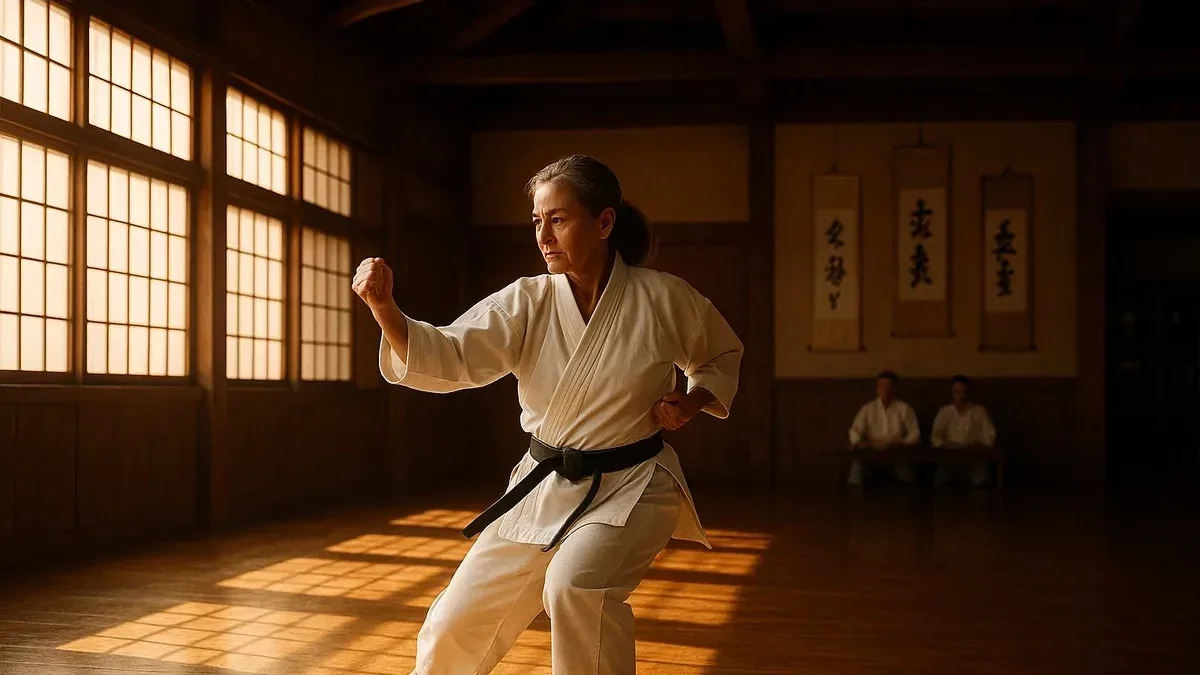
Most karate students reach a point where they can execute a kata from start to finish without hesitation, hit every stance, land every kiai on cue - and still have no real idea what they are training. That gap between technical competence and genuine understanding is where a lot of development stalls. This guide is for practitioners who want to close it.
What You Are Actually Drilling (And Why It Matters)
Kata is not choreography. It is a compressed record of fighting scenarios, linked together into a sequence you can repeat until the responses stop being conscious decisions and become instinctive ones. Every stance, every chamber position, every direction change corresponds to something specific - a particular attack, a particular range, a particular mechanical problem that needs solving.
The trouble is that most people learn the shape first and the meaning never. You memorise the order, you refine the appearance, and somewhere along the way the question of what this is actually for just does not get asked. The result is kata that looks presentable and does very little for your fighting ability.
The corrective is bunkai - the practical application that unpacks what each movement means against a real opponent. It should sit at the centre of kata training. In most dojos it gets a few minutes at the end of a session, if it appears at all. That is a structural problem, not a minor omission.
"Kata without bunkai is an elaborate warm-up. Kata with bunkai is a complete fighting system in compressed form."
A useful test: stop anywhere in your kata and explain, out loud, what you are doing and why - not a textbook answer, but a practical one, as if you are about to apply it. If you cannot do that for most of your techniques, you are drilling the container without the content.
The Mistakes That Keep Practitioners Stuck
Rushing is the most widespread problem at white and yellow belt level. It comes from anxiety about forgetting the sequence rather than any technical failure. When you are afraid of losing your place, you race through each technique to secure the next one before it disappears. The movements are present but they carry no weight, no breath, no intent. The fix is not artificial slowness - it is knowing the sequence thoroughly enough that you are no longer thinking about what comes next. Until you are there, slow down and accept that it looks unpolished.
Treating stillness as decoration is the next persistent error. The moment of settlement at the end of a technique - when your weight drops through your supporting leg into the floor - is structural, not aesthetic. If you are already moving toward the next technique before that settlement happens, you are always slightly adrift, never fully stable. Many practitioners feel this as a low-level floating sensation they cannot quite identify.
Performing rather than training is the one that lingers longest. Under observation - in gradings, in demonstrations - many students shift into a mode where they are attending to how the kata looks rather than how it feels. Those are genuinely different mental processes, and they produce different results. The gap between your training kata and your grading kata should be as close to zero as you can make it.
How Kata Connects to the Rest of Your Training
Kata, kihon, and kumite are not three separate subjects. They are one conversation. Kihon builds the mechanics. Kumite tests whether those mechanics hold under pressure. Kata sits between them, providing the context, the combinations, and crucially the transitions - the weight shifts, angles, and entry positions that make individual techniques work when they are chained together against a moving opponent.
What kata does that kihon cannot is force you to manage direction changes, multiple attack lines, and the connection between techniques across a sequence. In kihon you repeat one technique in a straight line. Kata breaks that open entirely. The body mechanics required to move well through a kata - particularly through the turns - are much closer to what a real exchange demands.
When the three elements are feeding each other properly, you feel it. Practitioners who avoid kata tend to develop compensations that limit them later. Practitioners who avoid kumite build clean technique that falls apart under any real pressure. Neither gap is acceptable if you are serious about the training.
A Checklist for Your Next Class
- Before drilling, pick one technique and ask what it is solving. Even a rough answer changes how you move through it.
- Slow down until the sequence is no longer something you are remembering. Speed without that foundation is just noise.
- Feel your weight settle after each technique before you begin the next one. If you are floating, you are rushing.
- Produce your kiai from your core, not your throat. Try it standing still first - feel what it does, then bring that into the kata.
- Train exactly the same whether or not anyone is watching. If your kata changes under observation, you are performing rather than training.
- Go back to an early kata and look for depth, not polish. If it feels the same as it did two years ago, something is not developing.
For the complete version, with every drill explained, read What Is Kata? A Guide to Karate's Solo Forms on Karate Lifestyle.
Join the conversation: X · Pinterest · Threads · YouTube
More from Karate Lifestyle


Comments
Post a Comment