Is Your Hip Actually Doing Anything When You Punch?
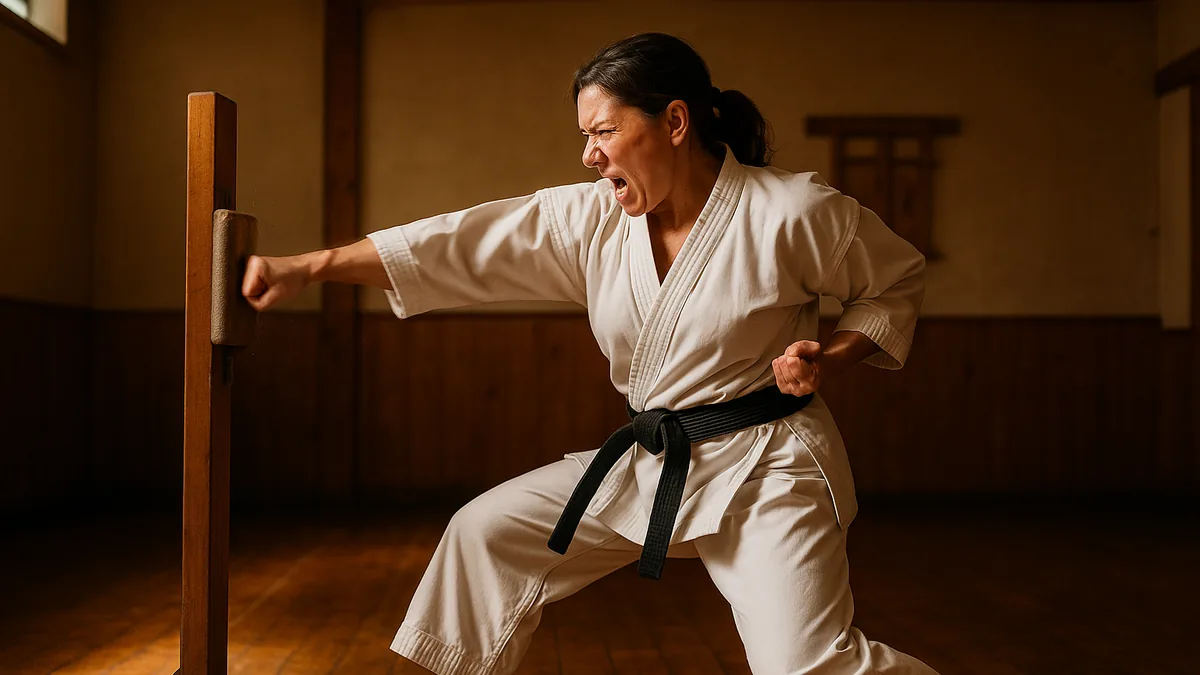
Most karateka who have been training for years would say, if asked, that they rotate their hip when they punch. Most of them are wrong - not because they are careless, but because the arm movement is so dominant that it masks everything else. If you want to know whether your hip is genuinely driving your technique or just coming along for the ride, this guide will help you find out.
The Chain Has to Start at the Ground
Power in gyaku-zuki does not begin at the hip - it begins at the back foot. The back leg presses into the ground, ground reaction force travels up through the leg, loads into the hip, and from there transfers through the core and out through the arm. The arm is the last thing to move, not the first.
This sequence - hip velocity peaking before shoulder velocity, shoulder before wrist - is exactly what biomechanical analysis of the technique shows. Understanding that order matters, because it tells you where to look when something is wrong. If your punch feels weak, the problem is almost certainly not your fist. It is somewhere earlier in the chain.
The practical check: stand in zenkutsu-dachi and forget the punch entirely. Drive your back hip forward and feel where the force loads. Feel the tension in your back leg and through your obliques. Then, and only then, add the arm. Most people feel the difference in power immediately, even at slow speed, because the arm has not changed - only the platform it is working from.
Hikite Is Half the Technique
The pulling hand is where a lot of practitioners quietly lose power without realising it. Hikite is not a passive movement you perform because the syllabus says so. The snap of the pulling hand back to chamber is what physically pulls the hip through its rotation. They are the same action. A lazy hikite produces a slow, shallow hip rotation, and a slow, shallow hip rotation produces a weak punch - every time, without exception.
If your hip rotation feels sluggish or disconnected, fix your hikite before you change anything else. It is the correction that tends to produce the most visible improvement in a single session.
Kime Is a Moment, Not a Clench
Kime is one of those concepts that gets explained early in training and misunderstood for years afterwards. The mistake most practitioners make is treating it as something applied after the technique reaches full extension - a sustained tension, a braking force. That produces stiffness and kills the snap entirely.
"Opponents feel the difference even when they cannot articulate it."
Kime is a sharp, brief muscular contraction that fires at the precise moment of completion and then releases immediately. It is not held. Think of it less like gripping and more like a whip cracking - there is a build-up of movement, a single focused point, and then it is done. You are already ready to move again.
A closely related error is holding the breath at the moment of impact. The sharp exhale - whether a full kiai or simply a controlled breath out - is part of kime, not separate from it. When the breath and the technique arrive at the same moment, the core engages properly and the force transfers cleanly. When they are separated, the whole thing loses its edge.
Why Slow Practice Tells You More Than Fast Practice
Speed hides disconnection. At full pace, your arm can be doing most of the work and you will not feel it - the movement is over too quickly. Slow the technique down to the point where you can feel every part of the sequence individually, and the truth becomes obvious. Is the hip and arm moving as one unit, or are they doing their own separate things? Is the back leg actively pressing into the ground, or just sitting there? Is the hikite genuinely snapping, or drifting?
If the connection is not there at slow speed, it is not there at full speed either - you just cannot feel it yet. Build the chain at slow speed until it is reliable, then bring the speed up. A properly connected, sharp hip rotation does not cost you speed in sparring. If rotation is slowing you down, it simply means it is not trained to that level yet.
Checklist for Your Next Class
- Check your stance first. Is your back leg genuinely driving into the ground, or is your knee collapsed and your stance shallow? Fix the platform before anything else.
- Drill the hip without the arm. Rotate from zenkutsu-dachi, feel the load, then add the arm last. Do this slowly before you do it at speed.
- Assess your hikite honestly. Is it snapping back with intention, or drifting? If it is drifting, that is where your power is going.
- Practise kime as a release, not a clench. Fire the contraction at the moment of completion and let it go immediately. It should feel like a crack, not a push.
- Exhale with the technique. Breath and kime arrive together. If you are holding your breath at impact, you are undermining the whole chain.
- Use slow practice to expose disconnection. If hip and arm are not moving as one unit at slow speed, do not add speed until they are.
For the complete version, with every drill explained, read How to Generate Power in Karate on Karate Lifestyle.
Join the conversation: Instagram · X · LinkedIn · Pinterest · Threads · Bluesky · YouTube
More from Karate Lifestyle


Comments
Post a Comment