Heian Shodan: What You're Actually Getting Wrong
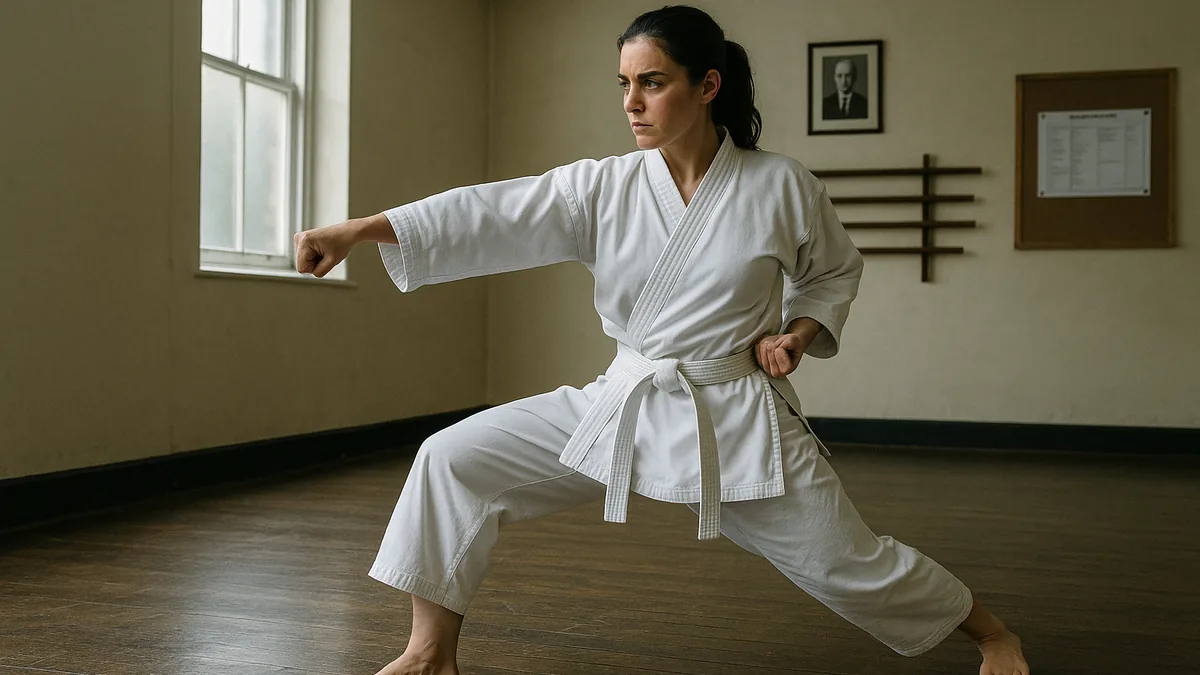
Most practitioners who have been training for a while will tell you that Heian Shodan taught them far more the second time around than the first. That is because the first time you learn it, you are learning the shape. The second time, you start to understand what the shape is supposed to do. This guide is aimed at helping you get to that second stage faster - whether you are a white belt learning the kata now, or a kyu grade who suspects some bad habits have crept in.
"The truth is that Heian Shodan is the kata that exposes everything."
The Timing Error That Affects Every Technique
If there is one correction that will improve your Heian Shodan more than any other, it is this: the block and the completion of the stance must arrive at the same moment. Not close together. Simultaneously.
The most common version of this error appears right at the start. The front foot lands, and then - a beat later - the gedan barai completes. It looks like two separate events because it is two separate events, and that is the problem. The hikite snapping to the hip, the blocking hand reaching its final position, and the front foot touching the floor should all happen as one unified action. When you get it right, the whole technique locks together at once rather than trickling into place.
This same principle carries through to the oi-zuki. Students who punch with their arm alone, without driving from hip rotation, are making the same underlying error - the technique is arriving in pieces rather than as a single committed moment. The hip rotation is not a bonus feature; it is where the power actually comes from. Without it, the arm is doing all the work, and the technique loses both its force and its meaning.
Stances: Build the Foundation Before You Move In It
Zenkutsu dachi and kokutsu dachi both cause problems in this kata, and usually for the same underlying reason: students try to find the stance while they are already moving into it.
A straightforward fix is to practise the stance statically before adding any technique. Stand in zenkutsu dachi for thirty seconds. Notice where the weight is sitting, whether the back leg is genuinely straight, whether the front knee is tracking correctly over the foot. Once that foundation feels established, add the block. Then add the step. You are building movement onto something solid rather than trying to construct and inhabit the stance at the same time.
For kokutsu dachi, a useful self-check is whether you could lift the front foot without significantly shifting your balance. If you cannot, too much weight is sitting forward and you are not genuinely in the stance.
The Shuto Uke Section: More Than Just More Blocking
The knife hand block sequence in the second half of the kata is where a lot of students switch off mentally, treating it as a repeat of what has come before. It is not.
The hikite in shuto uke should finish at the solar plexus, palm facing upward. This is different from the hikite position used during the punching techniques, and that difference is not cosmetic - it reflects a different type of technique with a different application. Ending the pulling hand at the hip in a fist, as though you are blocking in gedan barai, is a common mistake that quietly changes the entire character of the movement.
The head turn into each shuto uke also deserves attention. The head should snap to the new direction before the body turns, not at the same time. This applies throughout the kata, but it is particularly noticeable in the shuto uke transitions. Examiners see immediately whether this is crisp or sluggish, and it is one of the details that separates a considered performance from a mechanical one.
Checklist for Your Next Class
Take these into the dojo and work through them one at a time rather than all at once:
- Timing check - on every technique, ask whether the block or punch and the stance completion are arriving simultaneously. If you feel a gap, slow down and find the single moment.
- Hip rotation in oi-zuki - before your punching hand commits, is the hip already turning? The arm follows; it does not lead.
- Hikite in shuto uke - finishing at the solar plexus, palm up. Not at the hip, not in a fist.
- Head before body - on every directional change, the head snaps first. Practise the turn in slow motion until this becomes automatic.
- Static stance practice - spend thirty seconds in zenkutsu dachi before your first run-through. Build the foundation, then move in it.
- Zanshin at the finish - hold the final position with the same intention you brought to the opening move. The kata is not over until you choose to end it.
For the complete version, with every drill explained, read Heian Shodan Breakdown on Karate Lifestyle.
Join the conversation: X · Pinterest · Bluesky
More from Karate Lifestyle


Comments
Post a Comment