Goju-Ryu and Uechi-Ryu: What Actually Separates These Two Styles
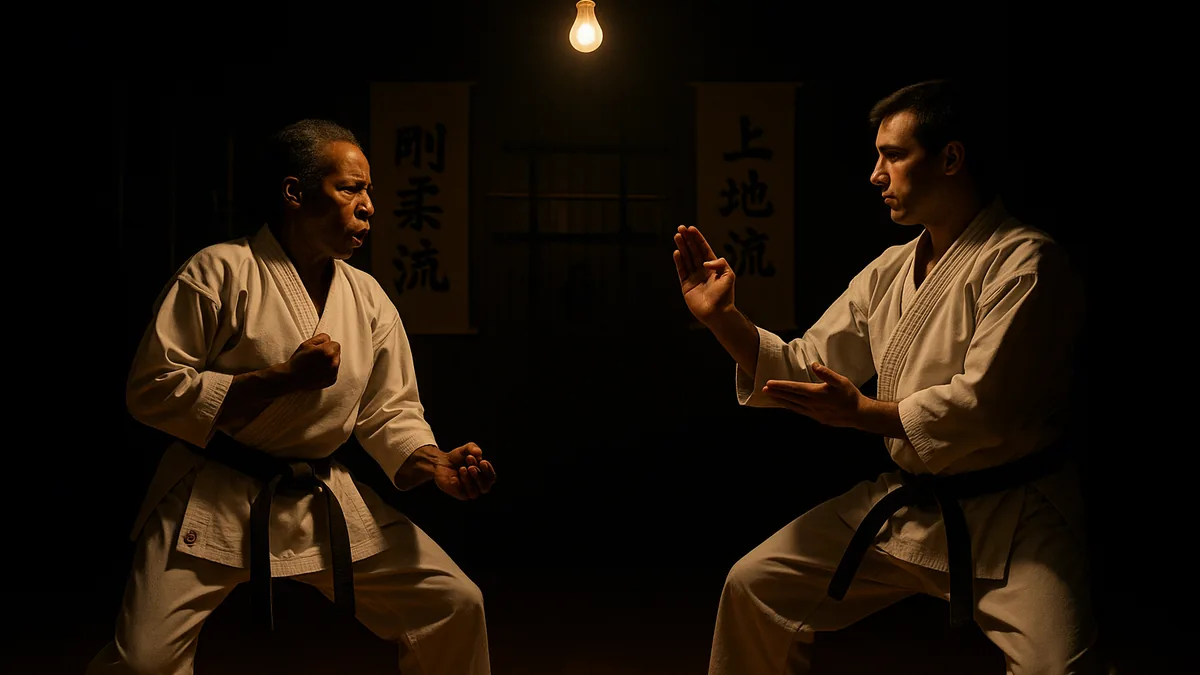
If you train in Goju-Ryu or Uechi-Ryu, you have probably been told at some point that the two styles are closely related - same island, similar ancestry, overlapping kata names. That is true as far as it goes. But spend serious time in both, and the differences in how each system builds a practitioner become impossible to ignore. This guide pulls out the practical points so you can take something useful to your next session.
The Roots Are Parallel, Not Shared
Both styles trace influence back to Fujian province in China, but through completely separate lines. Goju-Ryu developed through the Naha-te lineage, while Uechi-Ryu came from Kanbun Uechi's independent study in Fuzhou under his own teacher. The connection between them is one of parallel origin, not common descent. This matters because it explains why the two systems arrived at superficially similar ideas - close-range fighting, hard-soft principles, rooted stances - through genuinely different routes, and why those ideas are expressed so differently in practice.
Once you understand that, you stop expecting the systems to agree with each other and start paying attention to what each one is actually doing.
What Goju-Ryu Is Actually Building
The two areas where Goju-Ryu most often surprises people coming from other styles are breathing and circular technique.
In Goju-Ryu, ibuki breathing is not a sound you make alongside your techniques. It is a structural element that drives tension through the entire torso and makes the technique possible in the first place. When an experienced instructor checks your Sanchin by applying pressure mid-kata, you find out very quickly whether your breathing is doing that job or whether it is just noise. Most people discover it is just noise.
"The correction that usually works is to stop thinking about the exhalation as something you do at the end of a technique and start treating it as what makes the technique possible."
The circular deflections - nagashi-uke, mawashi-uke and similar movements - follow the same logic. They are designed to redirect incoming force rather than oppose it. The instinct under pressure is to push back, and that instinct is exactly what makes these techniques fail. Getting them to work means training yourself out of that reflex, which takes time and honest partner work.
What Uechi-Ryu Is Actually Building
Uechi-Ryu's characteristic weapons - the boshiken thumb knuckle strike, the nukite spear hand, the sokusen toe kick - are linear, penetrating, and aimed at specific anatomical targets. The training logic that follows from this is straightforward: if these are your primary tools, your body needs to be capable of using them without injuring itself in the process.
This is why body conditioning, including kotekitae forearm conditioning and general body hardening, is a standard part of Uechi-Ryu training in a way it simply is not in most Goju-Ryu dojos. It is not conditioning for its own sake. It is preparation for the actual techniques the style uses.
Sanchin kata appears in both systems, and comparing the two versions is one of the clearest ways to see the difference in priorities. Goju-Ryu's Sanchin is tested primarily for breath management and structural stability under pressure. Uechi-Ryu's Sanchin shifts the emphasis toward correct body alignment for technique delivery. The movements look similar. The diagnostic focus is different. Performing one system's version with the other system's emphasis will look wrong to any experienced instructor, even if you cannot yet feel why.
A Checklist for Your Next Class
- Check what your breath is doing. In Goju-Ryu, the exhalation should be driving tension through the torso before and during the technique, not finishing it off. If it feels like a sound, keep working.
- Test your circular deflections with a partner. If you are pushing back against incoming force rather than redirecting it, the technique is not working yet. Notice the instinct and train against it.
- Treat conditioning work as preparation, not performance. In Uechi-Ryu, body hardening exists because the primary weapons require it. Skipping it means avoiding the part of training that makes the techniques viable.
- Be clear about which system's Sanchin you are performing and why. Know what your version is testing before you perform it, especially if you are cross-training.
- If you are training in both styles, keep the principles separate. Applying one system's emphasis unconsciously to the other's kata produces technique that satisfies neither. Decide which framework you are working in and stay in it.
For the complete version, with every drill explained, read Goju-Ryu vs Uechi-Ryu: Two Naha-te Styles That Look Similar and Train Very Differently on Karate Lifestyle.
Join the conversation: Facebook · X · Pinterest · Threads · Bluesky
More from Karate Lifestyle


Comments
Post a Comment