Conditioning Striking Surfaces: What Your Club Probably Gets Wrong
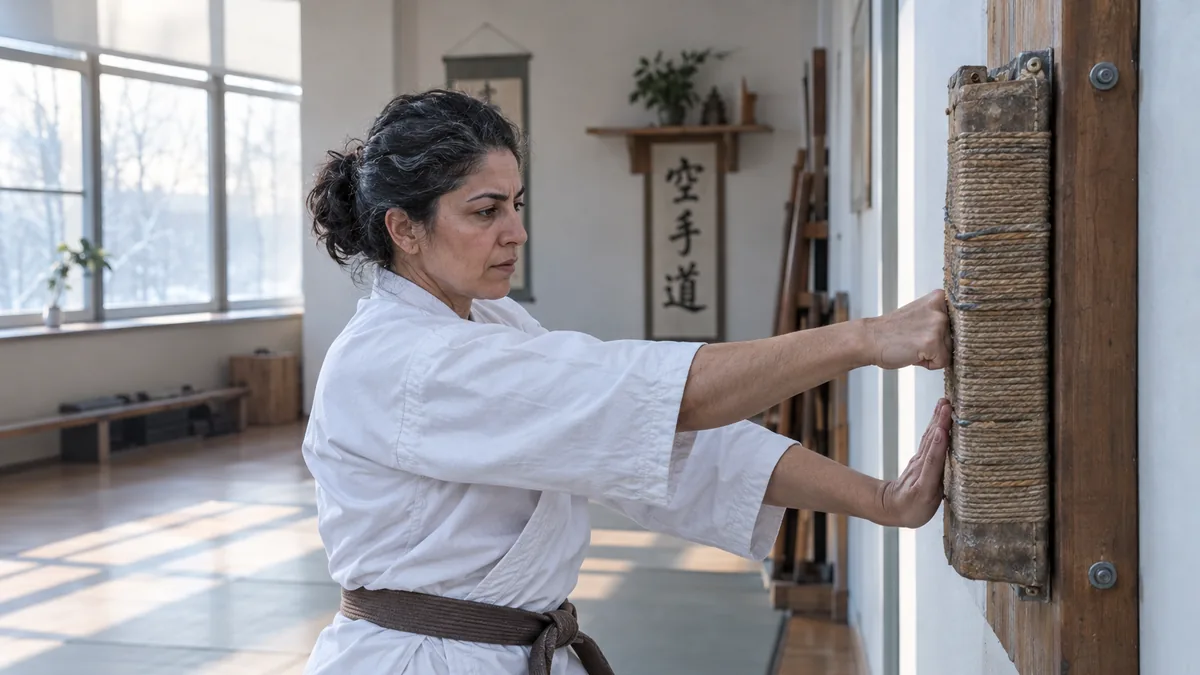
Most karate clubs treat conditioning as a side note - something you pick up over time, or do occasionally on whatever equipment happens to be available. The problem is that different striking surfaces have genuinely different requirements, different vulnerabilities, and very different consequences when the approach goes wrong. Getting this right matters whether you are a student or an instructor responsible for others.
The full article on KarateLifestyle.uk goes into the physiology, the specific techniques, and the risks in detail. This is a practical companion to help you take the key ideas straight to your next training session.
Why the Contact Point Is Everything
For seiken - the fore-fist - the relevant surface is the first two knuckles only: the index and middle finger metacarpophalangeal joints. Not all four knuckles. Punching with a flat fist spread across the full knuckle line might feel more stable, but it conditions the wrong area and trains an alignment that will not hold up when it counts. The force should travel through those first two knuckles in a direct line through the wrist and into the forearm. If it feels diffuse or unstable at the wrist, something is off.
For shuto - the knife hand - the contact zone is the fleshy, muscular pad along the edge of the hand near the little finger, not the bony ridge itself and not the little finger. Many practitioners make contact slightly too far toward the wrist or let the little finger take the impact. A slight pronation of the hand on contact helps bring the muscular pad forward as the striking surface.
"Alignment and mechanics come before surface hardness."
This applies to every surface. A heavily callused hand with poor wrist alignment is not a conditioned hand - it is just a rough one that is still at risk.
The Risks That Do Not Get Explained Clearly
Two risks in particular tend to be communicated poorly in traditional club environments.
The first is growth plate damage in younger students. Growth plates in the hand remain open through mid-adolescence, and repetitive high-load conditioning before they close can cause permanent damage. This is not a fringe concern - it is a straightforward physiological fact that many clubs ignore when putting young practitioners on hard conditioning equipment.
The second is ulnar nerve irritation from shuto conditioning on hard surfaces. The ulnar nerve runs along the inner edge of the arm and hand, and repeated blunt impact in that area can compress or irritate it. The signs are numbness or tingling in the little finger and part of the ring finger, sometimes accompanied by weakness in the grip. These symptoms are a signal to stop and get a medical assessment, not something to push through.
The fifth metacarpal - the bone underlying the shuto striking surface - is also worth treating with more respect than most practitioners give it. It is slender and relatively exposed, and the gap between productive conditioning and actual damage is narrower here than with knuckle conditioning. Progress should be measured in months, not weeks, and starting on soft surfaces before moving to harder ones is not optional.
Matching Conditioning to Your Actual Goals
Not every practitioner needs the same level of conditioning, and pursuing a higher standard than your training actually requires carries a real long-term cost to your joints. A competitor in full-contact knockdown karate has a genuine need for well-conditioned striking surfaces. A practitioner focused on kata and light contact kumite does not need to reach the same standard - and probably should not try to, given what sustained overloading does to joints over time.
The honest position is that the process of conditioning - patient, progressive loading with adequate recovery - matters far more than arriving at some fixed end point. Rushing the process causes injury rather than adaptation. Matching the goal to your actual training context keeps the cost proportionate to the benefit.
Checklist for Your Next Class
- Check your fist alignment before you touch the makiwara. The first two knuckles should be prominent and the wrist flat. If you cannot hold that under light load, reduce the force until you can.
- On shuto work, find the fleshy pad, not the bony edge. Pronate the hand slightly to bring that muscular surface forward before striking anything harder than a folded towel.
- If you are working with junior students, take growth plates seriously. Aggressive conditioning on hard surfaces is not appropriate for children and young teenagers.
- Any numbness or tingling in the fingers after edge-of-hand work means stop. Do not train through it.
- Progress shuto conditioning more slowly than you think you need to. Weeks on soft surfaces before moving to canvas or a makiwara pad is not excessive caution - it is the correct timeline.
- Ask yourself what you are actually conditioning for. If the answer is kata and light sparring, your conditioning standard does not need to match a knockdown competitor's - and your joints will thank you for recognising that.
For the complete version, with every drill explained, read Striking Surfaces and What You Should Actually Be Conditioning: Knuckles, Shuto, and the Risks Most Clubs Don't Explain on Karate Lifestyle.
Join the conversation: Facebook · Instagram · X · LinkedIn · Pinterest · Threads · Bluesky
More from Karate Lifestyle


Comments
Post a Comment