Bunkai That Actually Works: A Training Guide for Kata Practitioners
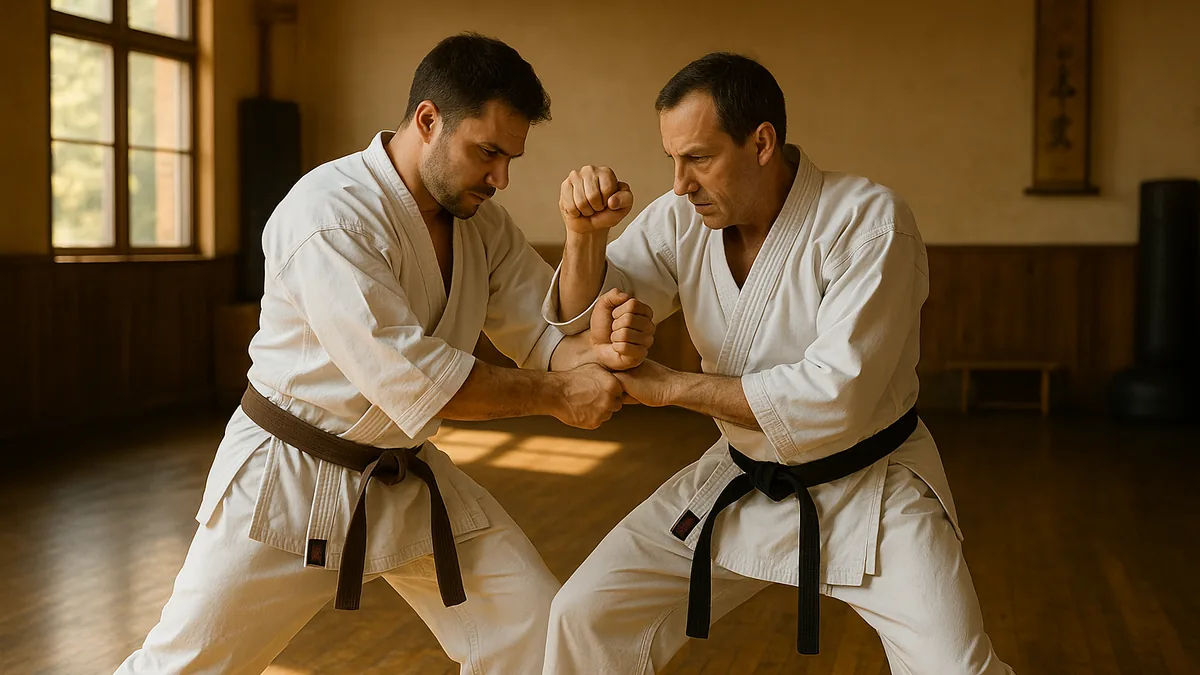
Most karate practitioners have done something called bunkai. Fewer have done bunkai that actually tells them anything useful. The gap between the two is not about grade or years on the mat - it is about how you frame the work and what you demand from your training partner. Here is a practical guide to help you get more from your next session.
Start With the Attack, Not the Technique
The single most important shift in bunkai training is changing the question you ask when you look at a kata movement. Most people ask: what does this movement look like? A downward sweep looks like a block, so it must be a block. A rising forearm looks like it deflects a strike, so that is what it does.
The more productive question is: what attack would make this movement necessary? That is a completely different kind of thinking. It forces you to consider range, angle, grip, and who has the initiative - rather than just matching shapes.
This matters because kata encodes principles about structure and range, not a fixed inventory of techniques with single correct meanings. A sweeping arm motion might be a block, a grab, a throw entry, or something else entirely - depending on what the attacker is actually doing. The kata does not change. Your understanding of it should, as your knowledge of how people actually fight develops.
The Three-Stage Drilling Method
Once you have a plausible application, drill it in stages rather than jumping straight to full-speed repetition.
Stage one is finding the application using the question above. Take a short sequence - three to five movements - and work out what attack the defender's first movement is responding to. Resist the temptation to settle on the first answer that looks tidy.
Stage two is slow drilling with a genuinely resistant partner. Resistant does not mean uncooperative for the sake of it. It means uke maintains real physical pressure - a genuine grip, real forward weight, no telegraphing. If your application only functions when uke stands still and waits, you have not found the application yet. You have found a performance of it. The feedback you need comes from the moments when the technique nearly fails: that is where the mechanics are revealing themselves.
Stage three is adding variability. Change the attack slightly. What if the grip is higher? What if the opponent pulls rather than pushes? A solid application will flex with the variable without breaking down entirely. If it collapses the moment anything changes, you have found one narrow expression of a principle rather than the principle itself.
"The kata doesn't have a fixed meaning waiting to be discovered. It has a structure that rewards serious inquiry."
Two Mistakes Worth Fixing Before Your Next Session
Training at the wrong range. A great deal of kata bunkai operates at very close range - inside punching distance, where grabbing and controlling are more relevant than exchanging strikes. When a sequence refuses to make sense, the most common fix is simply to step in. Many practitioners spend months trying to make applications work at sparring distance when the movement only resolves once you are close enough to feel the other person's structure. Try it before you abandon the application.
Treating uke as a prop. This appears at every level and it quietly ruins the training for both people. When uke throws the attack and then essentially switches off, the person drilling the application gets false confirmation that it works. But uke is also losing out - learning to feel your balance being broken, your structure compromised, your attack redirected is its own education. Both partners should be getting something from every repetition.
One more point worth raising: do not over-explain before your students have felt the mechanics. Giving the theory, the historical context, and the connections to other kata before anyone has drilled the movement means the explanation lands on nothing. Let people struggle with the physical reality first. Then the explanation has somewhere to go.
Checklist for Your Next Class
- Before drilling any sequence, ask what attack would make the first movement necessary - not what it resembles
- Brief uke clearly: real grip, real weight, genuine attempt to maintain pressure throughout
- If a sequence is not making sense, step inside punching distance before changing anything else
- After slow drilling, introduce one variable - height, direction, grip type - and see whether the principle holds
- Look at the transitions between techniques, not just the obvious strikes and blocks; turns and chamber positions are often where the most productive material sits
- At the end of the session, ask whether your understanding of the sequence has changed - if it has not, you may still be rehearsing rather than inquiring
For the complete version, with every drill explained, read What Is Bunkai? Training Kata Applications on Karate Lifestyle.
Join the conversation: X · Pinterest · Bluesky · YouTube
More from Karate Lifestyle


Comments
Post a Comment