Are You Using the Right Feedback Tool at the Right Time?
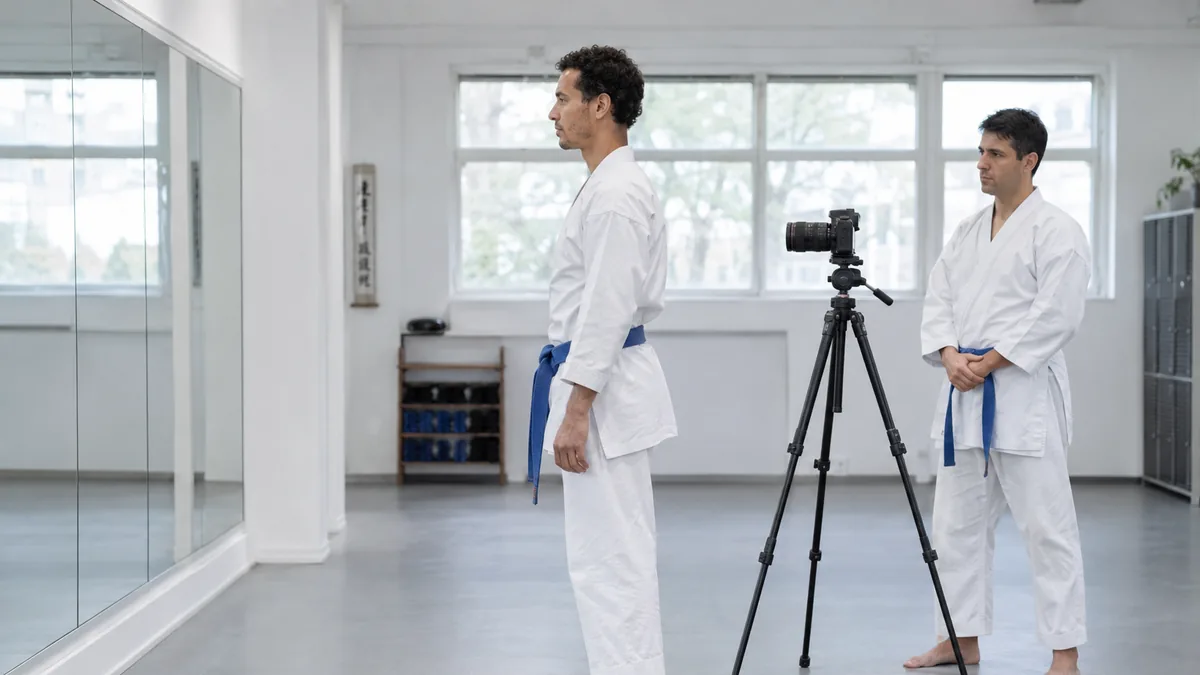
Most karate students have access to all three feedback tools - the mirror on the dojo wall, a phone camera, and a training partner - and use all three more or less randomly. The article we've linked below makes a strong case that the order and purpose matter as much as the tools themselves. Here's a practical breakdown you can apply straight away.
The Mirror Is for Checking, Not Watching
The mirror earns its place for static position work: confirming your kamae, spotting a collapsing guard, checking that your hikite is actually pulling back. That kind of immediate visual check is genuinely useful, especially when you're learning a new technique and need a rough map of what the movement should look like.
Where it goes wrong is when practitioners use it as a constant monitor during movement drills. Motor learning research describes this risk as the guidance hypothesis - leaning on external feedback so heavily during skill acquisition that you stop developing your own internal sense of what the movement feels like. The practical result is students who look composed in front of a mirror and fall apart in jiyu-kumite, because they've trained themselves to rely on visual information that won't be there when it counts.
The fix is straightforward: set your position, check it, then look away. Throw your combinations, then look. The mirror is a reference point, not a running commentary.
The Camera Catches What You Can't Feel
"The mirror shows you what you look like. The camera shows you what you did. A training partner shows you whether it works."
Most club-level practitioners underuse video, which is a genuine missed opportunity. At full speed, you have no conscious awareness of whether your back heel is lifting early, whether your guard is collapsing mid-combination, or whether small preparatory movements are telegraphing your attacks. The mirror can't show you any of this. A training partner might sense something is off without being able to name it. The camera shows you exactly what happened.
Side-by-side comparison with a senior instructor or high-level competitor in your style is particularly effective - research on this approach consistently shows better outcomes than self-observation alone. The gaps between what you're doing and what you're aiming for become obvious in a way that verbal correction often isn't.
The practical approach: film one technique or sequence per session. Pick one identified fault, work on it, then film again after several sessions to check whether the correction has actually taken hold or whether you've just shifted the problem elsewhere. Focused, deliberate review produces better development than passively watching everything back.
Training Partners Are the Real Test
Partner feedback is the most complete method available because it's the only one that tells you whether your technique functions. A gyaku-zuki that looks textbook-correct in the mirror might be consistently failing in kumite because the telegraphing gives your opponent a clear read. Only a partner surfaces that.
In kihon drilling, a partner feels whether your tsuki is landing with structure or just arriving with your arm. In bunkai, they reveal whether a technique was being performed as a visual shape or as something that actually works at the right angle and distance. In free sparring, they expose guard habits, predictable combinations, and distance management errors faster than any other method.
The limitation is that partner feedback is only as good as the partner giving it. Vague responses like "it felt a bit off" don't give you much to work with. A partner who can identify a specific fault and describe it clearly is a significant asset - that skill takes time to develop and shouldn't be taken for granted.
Checklist for Your Next Session
- Mirror: Use it to check your starting position and guard. Then look away before you move.
- Mirror: After a drill, glance back to confirm - don't monitor in real time.
- Camera: Film one technique or sequence only. Decide in advance what fault you're looking for.
- Camera: Compare your footage with a reference from a senior practitioner in your style.
- Camera: Review the same technique again after several corrective sessions to confirm the change has held.
- Partner: Ask for specific feedback, not general impressions. "Did my guard drop during that combination?" gets you more than "how did that feel?"
- Partner: In kumite, pay attention to what your partner is consistently exploiting - that's your most honest technical audit.
- General: As your proprioception develops, you should need the mirror less. If you're still dependent on it at intermediate level and above, that's worth addressing.
For the complete version, with every drill explained, read Mirror vs Camera vs Training Partner: Which Feedback Method Actually Improves Your Technique Fastest on Karate Lifestyle.
Join the conversation: Facebook · Instagram · X · LinkedIn · Pinterest · Threads · Bluesky
More from Karate Lifestyle


Comments
Post a Comment