Does Your Kata Actually Hold Up When the Floor Changes?
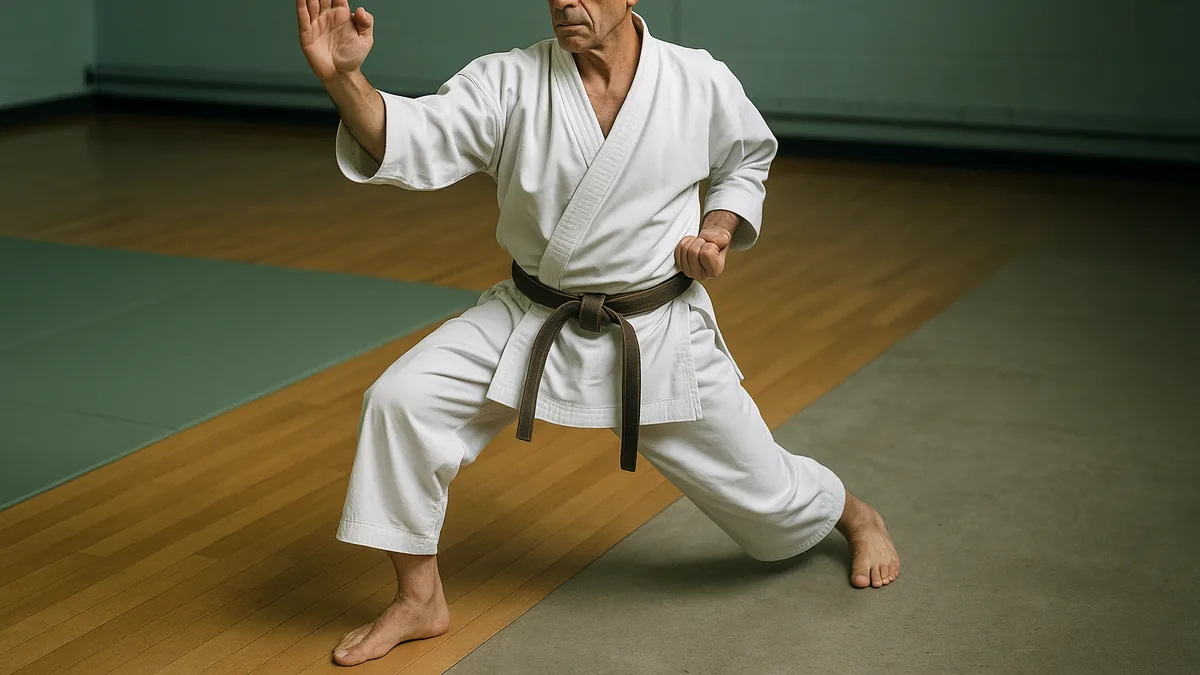
Most karateka spend their entire training life on the same dojo floor. That consistency feels like stability, but it can quietly build technique that depends on a specific surface rather than solid mechanics. The moment the floor changes - at a grading, a seminar, or an outdoor session - things start to slip in ways that are hard to diagnose on the spot.
This guide pulls out the practical points so you can take them into your next session.
Why Tatami Can Work Against You
Tatami is a generous surface. It grips your feet, cushions your drops, and absorbs a surprising amount of imprecision. That generosity is useful when you are learning new material, but it becomes a problem once you assume the kata is finished.
The most common habit tatami builds is what you might call a gripping pivot - where the foot pushes off the mat and friction does the rotational work. It looks clean. It probably feels clean. But the surface is compensating for a weight transfer that has not actually been completed. The heel barely lifts, the body barely commits to the new direction, and the mat quietly covers the gap.
The correction is to practise shifting the weight fully onto the supporting leg before the pivot begins, so the turning foot carries almost nothing when it rotates. When that is working properly, the pivot becomes surface-neutral - the foot turns because the body has already moved, not because the mat allowed it.
What a Hard Floor Will Tell You
Bare boards or concrete are not comfortable, but they are honest. Weight distribution errors that disappear into a mat become immediately noticeable when there is no cushioning to absorb them. A front stance that felt solid on tatami will expose a rearward lean. A pivot that worked on grip will either lock up or overshoot.
The adjustment is straightforward: slow the weight transfer slightly until you have recalibrated to the surface, and allow the heel to lift a fraction earlier in the rotation. You are not changing the technique - you are removing the part of it that was never really technique in the first place.
If you have knee concerns, approach hard floor work carefully. Slow repetitions with full attention to each placement are far more useful than rushed ones that grind your joints.
"If you can only perform your kata well on one specific surface, that tells you something about how deeply the technique is embedded."
Outdoor and Uneven Surfaces
Grass, gravel, or any uneven ground introduces a different problem: instability underfoot means some pivots simply cannot be executed the way tatami allows. The answer is not to force them. Step through the direction change instead of rotating on the spot. The movement principle the kata is training remains intact; the exact foot path is a detail the surface has made impractical.
This is worth sitting with, because it cuts against the instinct to replicate the kata exactly regardless of conditions. The kata is a vehicle for the mechanics, not a ritual to be preserved at the cost of your ankle.
A Checklist for Your Next Class
- Pick one kata you consider solid and perform it on your normal surface, paying attention to every pivot
- Find a hard floor - changing room boards, a sports hall, a garage - and repeat it there without trying to perform perfectly; just notice what changes
- On the hard floor, check whether your heel is lifting early enough in pivots or whether you are relying on friction to finish the rotation
- In any pivot, confirm the weight is fully shifted before the rotation begins - the turning foot should be light
- If you train outdoors, accept that some pivots will become steps; do not force a rotation on wet or uneven ground
- After each surface, note one specific thing that felt different or fell apart - that is your actual training target
For the complete version, with every drill explained, read Performing Kata in Bare Feet vs on Tatami vs on a Hard Floor: How Surface Changes What You Feel and What You Should Adjust on Karate Lifestyle.
Join the conversation: X · Pinterest · Threads · Bluesky · YouTube · TikTok
More from Karate Lifestyle


Comments
Post a Comment